Monday, October 16, 2006

Human Arts Ensemble: Whisper of Dharma

Some info:
Artist: Human Arts Ensemble
Whisper of Dharma

1. Whisper of Dharma
2. A World New

Charles Bobo Shaw - drums, small instruments
Joseph Bowie - trombone, congas, small instruments
Oliver Lake - tenor sax, radong, flute, small instruments
James Marshall - alto sax, radong, wooden flutes
J.D. Parran - tenor and sopranos saxes, bass clarinet, small instruments
Floyd Leflore - trumpet, small instruments
Gene Lake - drums, small instruments
Baikida E.J. Carroll - gong, small instruments

Recorded on October 6, 1972 in St. Louis, MO

Label: Committee for Universal Justice
The crew on this record include the same cats who appeared on the Black Artist Group record I uploaded earlier this month (BAG: In Paris, Aries 1973), augmenting that quintet with additional musicians. Just a bit about the group:
The Human Arts Ensemble was a musical and theatrical cooperative founded in St. Louis, MO, in 1971 by free jazz musicians who had been associated AACM and BAG (Black Artist's Group). Around 1970, public funding began to dry up for arts organizations that were suspected of having ties to radical political groups, and drummer Charles Bobo Shaw had the idea of creating a new artistic co-operative that was open to any person without regard to race. The resulting Human Arts Ensemble was thus able to proceed within a radical political agenda and pursue its unique brand of guerilla theater, yet get the public support it needed to do so.
The first track ("Whisper of Dharma") starts out with the sound of a gong and horns that sound like something out of a Tibetan monastery. Although definitely on a free improv tip, the music is very meditative leaving plenty of open space and utilizing a lot of "small instruments" - you're more likely to hear the sound of a bird chirping than a rollicking jam session. Fits in very well with what Art Ensemble of Chicago and Marion Brown were doing circa 1970. Whereas the first track whispers, the second track screams. The second track ("A World New") is where these cats kick out the jams. The music is LOUD - the birds are still chirping, but over the sounds of hollers, drums, saxes and brass instruments leaving the listener to realize the revolution won't be televised: it's coming right out of the speakers! AEC's "Baptizm" might be a fair reference point for this one.

Personally, this is turning into one of my favorites since I first stumbled onto it a few months ago.

The sound should be good - ripped from vinyl (in very good condition - not many crackles or pops), 192 kbps mp3.

As far as I know, this particular album has never seen a proper cd reissue. Maybe someday.

Download Whisper of Dharma.

Updated 10/20/2006

Download Whisper of Dharma.

Thursday, October 12, 2006

Mtume: Kawaida


Kawaida is an interesting and problematic recording. The problematic element is whom to credit as band leader. At various points it's been credited to Albert Heath (or at the time Kuumba Toudie Heath - see album art above) and Herbie Hancock (on one of the CD reissues from the 1990s). Over at the Kozmigroov connection and at Jazz Supreme it's been suggested that the album really should be credited to Albert Heath's nephew, James Mtume.

According to The Kozmigroov Connection, the album was first issued on a label called O'Be in 1970. The album was also issued by a label called Trip Records. According to Allmusic.com, in 1976 the album was issued under Herbie Hancock's name on a label called GB (catalog # 22008). Twenty years later, the album was issued on cd, again under Herbie Hancock's name (simply titled The Jazz Masters) on an Italian label called the Folio Collection. To my knowledge, it's currently out of print. Every once in a while the album shows up on ebay - usually fetching around $30-$35 (I obtained my copy for about $5 from some merchant who had no idea that this was some sort of Holy Grail recording among underground jazzheads).

Confused? Maybe one day we'll get the lowdown. I won't hold my breath.

There's no doubt that the album was a Heath family joint, with Albert (Mtume's uncle) handling the drum set, Jimmy (Mtume's dad) handling the sax chores, and Mtume contributing the fine conga playing and spoken word. Mtume wrote four of the five tunes (Baraka, Kamili, Maulana, and Kawaida), with Albert contributing the other tune (Dunia). The list of musicians is certainly impressive, and includes a number of heavyweights outside the Heath family, such as Ed Blackwell, Herbie Hancock, & Don Cherry.

The music speaks for itself, and can be characterized as having a distinct modal, percussive, cosmic feel to it. The first two tracks, the mid-tempo "Baraka" & and the slower "Kamili" are pleasant modal, soulful jams that fit in quite well with what was going on in the immediate post-Coltrane era. Herbie Hancock get's featured front and center on both tracks and sounds right at home with the music - it fits in (minus the electronics) with Hancock's Sextant recordings of the late 1960s & early 1970s (you could also easily play these tunes alongside of just about anything from McCoy Tyner's excellent album Asante). Just check out the opening of "Baraka" - Herbie gives the session a profound and haunting beginning. "Dunia" (Albert Heath's tune) is the closest the album comes to free jazz - that track features Don Cherry's trumpet very prominently, and the whole crew kicks out the jams and sets the studio on fire. If the first two tracks put you into a meditative trance, "Dunia" will wake you right back up. The final two numbers, "Maulana" and "Kawaida" are where we hear the roadmap for Mtume's subsequent jazz explorations - both numbers are contemplative, percussion-laden, and include spoken-word statements with a distinctly Black Nationalist message (especially on the final track, "Kawaida"). The vibe is very positive, spiritual, and nothing short of revolutionary. The mix of musicians is just right (these cats were all on the same wavelength for this session) - there isn't a weak moment on this record. If you've been digging on the other stuff I've shared so far, don't miss this one!

As Ian Scott Horst of Jazz Supreme sez:
Capsule Info: Not wanting to fork out $40 for a used copy I've settled for a taped dupe. This is more properly, I'm told, Albert's son [editor's note: Mtume is Jimmy Heath's son; Albert Heath is Mtume's uncle] Mtume's first album, and certainly it bears his percussive, and declaratively African nationalist stamp all over it: it's the prequel to Mtume's own ALKEBU-LAN, LAND OF THE BLACKS. It's a great album, with Herbie Hancock at the height of his jazz playing, swahili invocations, lots of percussion, and a deep spiritual vibe throughout.
Tracks:

1. Baraka (13:12)
2. Kamili (5:48)
3. Dunia (8:29)
4. Maulana (9:45)
5. Kawaida (7:39)

Note that the track listing here is from the CD version: the order on the original LP version appears to have been different.

Personnel:

Ed Blackwell - Bells & Percussion
Billy Bonner (Fundi) - Flute, Percussion (track 5 only)
Don Cherry (Msafari) - Trumpet
Herbie Hancock (Mwandishi) - Piano
Albert "Toudie" Heath (Kuumba)- Drums & Percussion
Jimmy Heath (Tayari) - Sax (Soprano), Sax (Tenor)
Mtume - Conga, Voice
Buster Williams (Mchezaji) - Bass

Recorded December 11, 1969. Produced by O'Be Productions. Recorded at The Universe, and Mastered at Town Sound Studios. Released 1970 on O'Be Records, catalogue number OB-301. Trip Records release is catalogue number TLP-5032. Liner notes on the O'Be Records edition written by Amiri Baraka.

Ripped from cd, 192 kbps.

Download it here.

Updated 10/20/2006 and 11/28/2008

Download it here.

Wednesday, October 11, 2006

A partial wish list

Since Rainbow Demon asked in the comments, I thought I'd share with y'all some of the recordings I've been trying to track down. If someone here has already got one of these on upload or is willing to shoot some files my way, I'd be tremendously grateful.

Arthur Doyle/Hamid Drake - Your Spirit is Calling (2004, Qbico)
Arthur Doyle Electro-Acoustic Ensemble - National Conspiracy (2004, Carbon [part of Carbon's CDR series & now OOP] - a remix album of tunes from Conspiracy Nation, etc.)
Rick Colbeck Quartet - The Sun is Coming Up (1970, Fontana)
The Marzette Watts Ensemble - The Marzette Watts Ensemble (1967, Savoy)
Black Artists Group - In Paris, Aries 1973 (1973, BAG)
Frank Wright - Shouting the Blues (1977, Sun Records)
Frank Wright - Kevin My Dear Son (1978, Sun Records)
The Last Poets - At Last (1976, Blue Thumb)
Sam Rivers - Black Africa! Villalago (1977, Horo)
Sam Rivers - Black Africa! Perugia (1977, Horo)
Sam Rivers - Paragon (1977, Fluid)
Albert Heath - Kwanza [The First] (1974, Muse)
Abdullah Ibrahim (Dollar Brand) - African Space Program (1973, Enja)

EDITED AND BUMPED! (10/6/2006)

And once more (10/11/2006). It's kind of cool to be able to mark some of these as found. I thought I'd managed to get a hold of Frank Wright's Kevin My Dear Son, but the mp3s that I see circulating are mangled - it's a bit jarring to be grooving on the title track only to hear the AOL "You've Got Mail!" message interrupt the proceedings. So, I'm still on a quest for that album, and it's personal with me (my first-born's name is Kevin, nuff said).

Monday, October 9, 2006

Re-upping a few albums

By request, I am re-upping some albums on rapidshare. Let's face it: rapidshare is not exactly an ideal solution, if for no other reason than that links go bad very quickly, it's not terribly foregiving to those downloading via dialup, and even with a decent connection, getting files uploaded is fairly time-consuming. For now, until I stumble upon something better we'll just make do. My suggestion is that if you've stumbled onto this blog and you find something you like throw caution to the wind and download asap. I don't mind re-upping though keep in mind that I may need a few days to do so depending on how heavy my schedule is.

The Positive Force w/Ade Olatunji: Oracy (new download link for Oracy)

Miles Davis: Lost Mid 70s Sessions (new download links for album 1 and album 2)

Dewey Redman: Coincide (new download link for Coincide)

Mtume: Rebirth Cycle


Mtume: REBIRTH CYCLE

Third Street Records, TSJ 100. Recorded at Minot Sound, February 1974; Released 1977. Produced by James Mtume. All tracks written and arranged by James Mtume.

Track list
1. Sais
2. Yebo
3. Cabral
4. Body Sounds
5. Umoja

Musicians
Mtume, congas (track 4), piano (track 2)
Jean Carn, vocals (tracks 1 & 5)
Dee Dee Bridgewater, vocals (track 1)
Tawatha (Agee), vocals (tracks 2 & 5)
Onika, vocals (track 5)
Carol Robinson, vocals (track 5)
Shirley Jenkins, vocals (track 5)
Muktar Mustapha, poet, narration (track 1)
Jimmy Heath, reeds (tracks 1, 3, 5)
Azar Lawrence, reeds (tracks 1, 3, 5)
John Stubblefield, reeds (tracks 1, 3, 5)
Stanley Cowell, piano (tracks 1, 3, 5)
Bayeté, electric piano (track 2)
Reggie Lucas, guitar (tracks 1, 3, 5)
Pete Cosey, guitar (track 2)
Buster Williams, bass (tracks 1, 3, 5)
Cecil McBee, bass (tracks 1, 3, 5)
Michael Henderson, bass (track 2)
Leroy Jenkins, violin (tracks 1, 3, 5)
Dierdre Johnson, cello (tracks 1, 3, 5)
Billy Hart, drums (tracks 1, 3, 5)
Andrei Strobert, drums (tracks 1, 3, 5)
Al Foster, drums (track 2)

Some reviews:
With credits that read like a who's who of early 1970s jazz, Mtume, then with Miles Davis, produced his third solo album, including one cut with the Miles Davis band sans Miles. This album is full of spirituality, Africanisms, and real jazz. "Umoja" even includes invocations to Obatala, Yemaya, and the other deities of the Yoruba religion/Santeria. Fascinatingly, Mtume and Lucas went on to produce funk, and then disco, and then Madonna, all with a trademark conga plus electric guitar sound. There, I always wanted to include Madonna in this website. (Ian Scott Horst)

Rebirth Cycle is an amazing lineup (see Ian's discog listing at for details) whose African roots are clearly breaking the surface. "Sais" is a sidelong cut initiated by a bass clarinet ostinato and textured with dense percussion and multiple voices (Jean Carn, Dee Dee Bridgewater, Tawatha Agee, damn!) and some absolutely penetrating narration. Also included is "Yebo", an electric cut with the Miles '74 players (Cosey, Foster and Henderson) that's more soul-jazz than what the players might suggest, and this weirdo percussion piece called "Body Sounds". [DW - freeform.org]

Rebirth Cycle, though released in 1977, was actually made in 1974, and the album’s personnel list reads like a veritable who’s-who of the musicians who where working in the more independent jazz scene of the early seventies. Working on this album, you had Dee Dee Bridgewater and Jean Carne on vocals. Strata East players like Cecil McBee and Buster Williams on bass, Stanley Cowell on piano and Jimmy Heath on reeds. This album is also the first introduction to the mighty voice of Tawatha Agee who would remain the co vocalist with the Mtume band right through to the mid eighties.

Musically, Rebirth Cycle is a fusion of afro-centric deep jazz and psychedelic spacey funk. The main piece on here, and the album’s high point, is the side long “Sais” (sigh-us). This 20 plus minute tune starts with the spoken introduction by Senegalese poet Mustapha, explaining the story of “Mystery System of Sais, the Egyptian school of higher learning from which Greek and Western philosophy was developed”. Once the introduction is over one of the most magical and hypnotic musical 20 minutes you could sit through begins. From the slow and haunting bass clarinet solo through crashing waves of vocal chaos plus one almighty guitar solo by Reggie Lucas, all backed by a solid groove that is cut so deep it would be impossible to climb out of, even if you wanted to. There are moments in this piece where the cacophony is such that it feels like you’re consumed in a hypnotic aural cloud, and you find yourself not wanting to come out of it, or at least for the tune not to come to an end. Then the chaos ebbs away, the bass clarinet solo slowly unearths itself from the onslaught of the other instruments and the poetry returns. You then find yourself coming to from this 20 minute musical roller coaster ride, and you cannot help but feel total exhilaration. On Side two of this album the tracks are shorter in length and are much more afro-centric funk in style. The vocal work on this side of the album is truly sublime, whether it is “Yebo” the Oneness Of Juju style groover with magical vocals by Tawatha Agee, the haunting beauty of Jean Carn’s performance on Cabral, or the traditional African nasal style on the closing track “Umoja”. Rebirth Cycle does not contain a weak moment anywhere on the entire recording, and is really worth seeking out a copy.

[Nick, freeform.org]
Download it here.

Like a lot of great underground jazz recordings of the period, this one has never seen a proper release. James Mtume's primary contributions to this album were primarily in the form of production, songwriting and arranging, although he does play on a couple of the tracks. The lyrics are less strident than the previous two albums (Kawaida, and Alkebu-Lan), but still positive and aware. "Sais" is probably the track that most seek out, and at 20 minutes sounds and feels like something straight out of Alkebu-Lan. The remaining tracks are shorter, and vary in sound and texture. "Umoja" and "Cabral" are both lovely, delicate ballads - the first overtly Afrocentric, the second a soul-jazz tune featuring Jean Carn on vocals. "Body Sounds" is a percussion piece that begins with some hand clapping & what sounds like chests being slapped - the echo becomes noticeable as the tune progresses and gives "Body Sounds" an almost psychedelic feel (it's my favorite track from side two). "Yebo" is a more uptempo funk tune that could almost fit in with Miles Davis or The Headhunters (or for that matter Oneness of Juju), and can be viewed as a harbinger of where James Mtume was heading for the remainder of the 1970s.

Updated 10/20/2006 and updated again 11/27/2008.

Download it here.

Sunday, October 8, 2006

Mtume Umoja Ensemble: Alkebu-Lan - Land of the Blacks


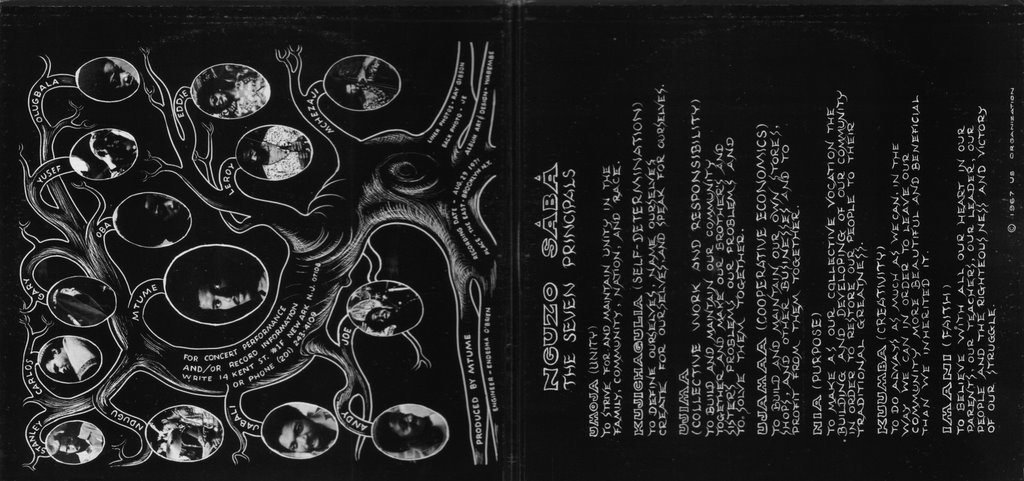
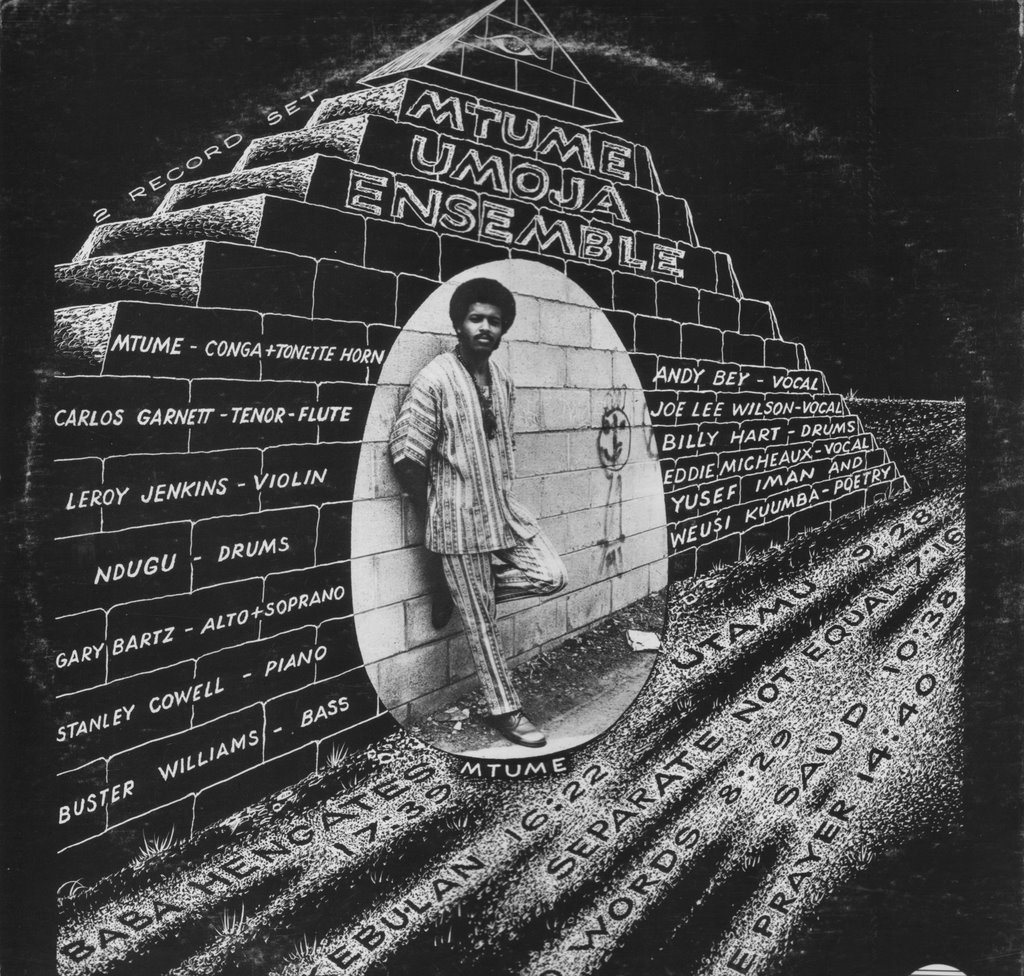
The cover art (above): Front cover, Inside cover, Back cover. Click the pix to see them full-sized.

The information:

Mtume Umoja Ensemble

Alkebu-Lan: Land of the Blacks

1972 Strata-East (catalog # SES 19724)

Recorded August 29, 1971 at The East, Brooklyn, NY.

Tracks:

A1: Invocation (4:08)
A2: Baba Hengates (17:28)

B1: Utamu (9:58)
B2: Saud (10:32)

C1: Alkebu Lan (16:29)
C2: No Words (8:32)

D1: Separate Not Equal (7:26)
D2: The Prayer (Sifa Zote)...Outro (15:56)

Personnel:

James Mtume - Conga, Tonette Horn
Carlos Garnett - Tenor Sax, Flute
Leroy Jenkins - Violin
Ndugu - Drums
Gary Bartz - Alto Sax, Soprano Sax
Stanley Cowell - Piano
Buster Williams - Bass
Andy Bey - Vocals
Joe Lee Wilson - Vocals
Billy Hart - Drums
Eddie Micheaux - Vocals
Yusuf Iman & Weusi Kuumba - Poetry

Credits:

James Mtume - Producer
Endesha O'Brien - Engineer
Ray Gibson - Liner Photos
JE - Back Photo
Wabembi - Album Cover Art & Design
Review:

Capsule Info: Recorded August 29, 1971 at The East, New York. According to Jim Flannery of the Kozmigroove Mailing List, it's "Pretty damn wild...AACM goes to Africa... but I guess I'd have to add 'Pharoahs go to Saturn' to get the picture complete. Starts out with a four-minute speech describing the role of 'these jams' in the service of Black Nationalism... and then backs it up. Cover is black with white line-drawing of a sorta Egyptian-meets-subSaharan figure (Pharoanic beard, pyramids for eyes, goat amulet), back side has an eye-in-pyramid drawing with photo of Mtume leaning against it." Having finally heard this record finally, I love it. While it's certainly dated, it's a fascinating glimpse of the marriage of early 1970s Afro-centric music, politics and spirituality, plus it really grooves. To me reminiscent of Bartz' Ntu Group work, it's more energetic and colorful than those records. A treasure: Strata-East was an extraordinary label. (Ian Scott Horst: Jazz Supreme)
James Mtume was born James Foreman, and is the son of sax player Jimmy Heath. He's probably best known for his funk/r&b combo Mtume which scored a hit with "Juicy Fruit" back in 1983. He also has done some production work (e.g., The Bar Kays album Animal) and composed the music & theme song for New York Undercover (a cops & robbers drama from the early 1990s). If I recall correctly he's been director of a New York theatre and a community activist in his adopted city of NYC.

Before all that, he was a jazz percussionist (given the influence of his dad & uncles - i.e., The Heath Brothers no huge surprise) who was a regular member of Miles Davis' touring & recording group from 1971 through 1975 and an occasional band leader in his own right. Alkebu-Lan is the first album to appear under his own name although there is some speculation that Kawaida (a late 1960s kozmigroov classic) is truly his first as a leader (see Ian Scott Horst's site for more detail - sometimes it's credited to Albert Heath, sometimes to Herbie Hancock). His last album in the jazz idiom would be Rebirth Cycle, recorded in 1974, but not released until 1977.

The files are 192 kbps mp3s, ripped from vinyl. Expect to hear some pops, etc., though thankfully the vinyl recordings seem as if they had been well-cared for.

The music itself fits in very nicely with the music from The Black Artists Group (see previous blog entry), as well as cats such as Human Arts Ensemble, early 1970s Art Ensemble of Chicago, and early Juju (Plunky Branch's great band that also recorded on Strata-East). The album opens with a four minute speech outlining the album's purpose and then kicks out the jams. Since this is a live album, there is plenty of speaking in between tunes. The tunes themselves have a very free feel to them, with plenty of percussion, chanting, spoken word, and intense jamming throughout. The music holds up well nearly three and a half decades later, and just reading the credits it's easy to understand why - these cats were for the most part well-known and well-respected performers. The extent to which the spoken sentiments are "dated" I suspect will depend on who you're talking to.

Don't miss out. The album went out of print and as far as I know was never reissued on cd - a fate shared by many other wonderful Strata-East records from the era. For those of us who dig this particular form of improvised music, Alkebu-Lan is something of a Holy Grail & the vinyl (if you can find it) will fetch a premium.

This excellent recording is split into two parts: Album 1 (sides A & B) and Album 2 (Sides C & D).

Updated 10/20/2006

This excellent recording is split into two parts: Album 1 (sides A & B) and Album 2 (Sides C & D).

Saturday, October 7, 2006

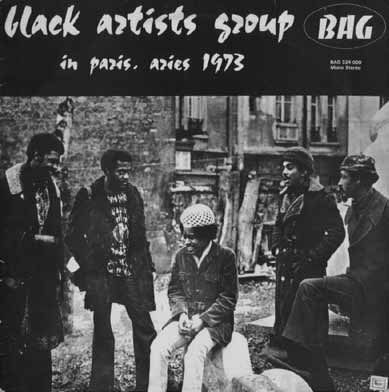
Black Artists Group: In Paris, Aries 1973


You can download the album here. This particular album was found via the miracle of p2p. From the notes that came with the downloaded files (which by the way sound quite good - 320 kbps mp3s from vinyl):
Band : Black Artists Group
Album : In Paris, aries 1973
Year : 1973
Label : BAG
Cat # : BAG 324 000

-----------------------------------------------------------------
# Title Aritst

Program 1
A1 . Echos (Bowie, Lake, Shaw, Le Flore, Carroll)
A2 . Something To Play On (Shaw)

Program 2
B1 . Re-Cre-A-Tion (Lake)
B2 . OLCSJBFLBC (Bowie, Lake, Shaw, Le Flore, Carroll)
-----------------------------------------------------------------

Joseph Bowie : Trombone, Conga, Miscellaneous Instruments.

Baikida E.J. Carroll : Trumpet, Flugelhorn, Bass, Log Drum, Cowbells, Miscellaneous Instruments.

Charles W. Shaw, JR "Bobo" : Drums, Woodblocks, Gong, Miscellaneous Instruments, Stylophone. Under The Sun

Floyd Le Flore :Trumpet, Miscellaneous Instruments, Voice.

Oliver Lake : Saxophones, Flûte, Marimbas, Mud Drums, Miscellaneous Instruments.

This Music Recorded Live in memory of Kada KAHAN
RECORDED LIVE IN PARIS - ARIES 1973

------------------------------------------------------------------
A short review taken from "TOP TEN FROM THE FREE JAZZ UNDERGROUND" by Thurston Moore

The Black Artists Group was an unit not unlike that of The Art Ensemble of Chicago. Except they only recorded this one document and it only came out in France on a label named after the group. This is squeaky, spindly stuff and very OPEN and a good indication of what was happening in the early 70's with members Oliver Lake (later of the infamous World Saxophone Quartet) and Joseph Bowie (Art Ensemble's Lester Bowie's bro, later to start Defunkt).
If you like Art Ensemble of Chicago (circa the 1970s) and the Human Arts Ensemble, you'll like this recording. Needless to say, this music is hard as hell to come by.

See also: Poets of Action: The Saint Louis Black Artists' Group, 1968-1972 (Part 1-4) by Benjamin Looker to learn more about the group.

Updated 10/20/2006

DownloadIn Paris, Aries 1973.